Authentic UMF™ Certified
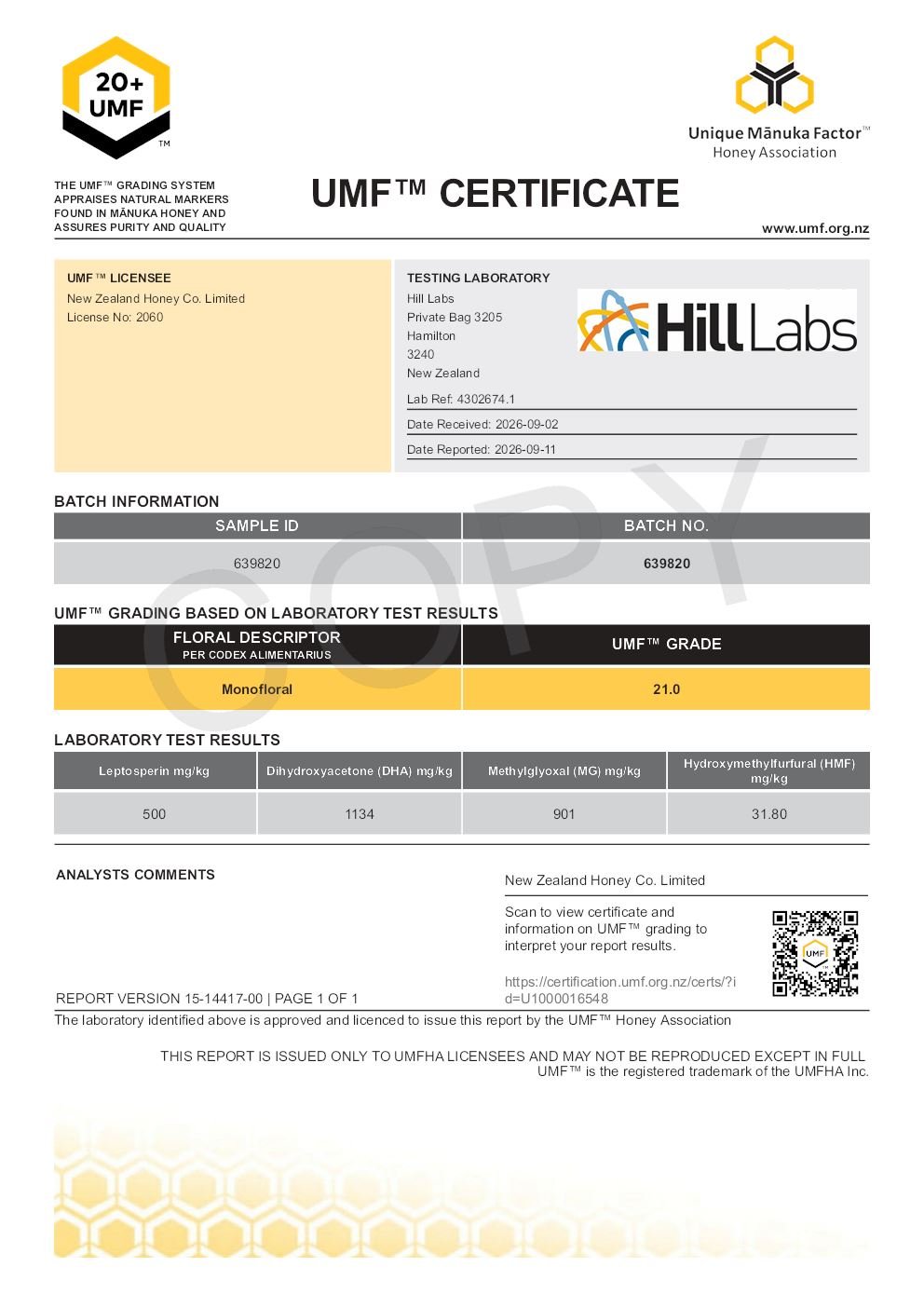
UMF™ Certificate: Batch ID: #639820
Testing Laboratory

Valid Certificate Search
Monofloral
UMF™ GRADE
21+

Product Verification
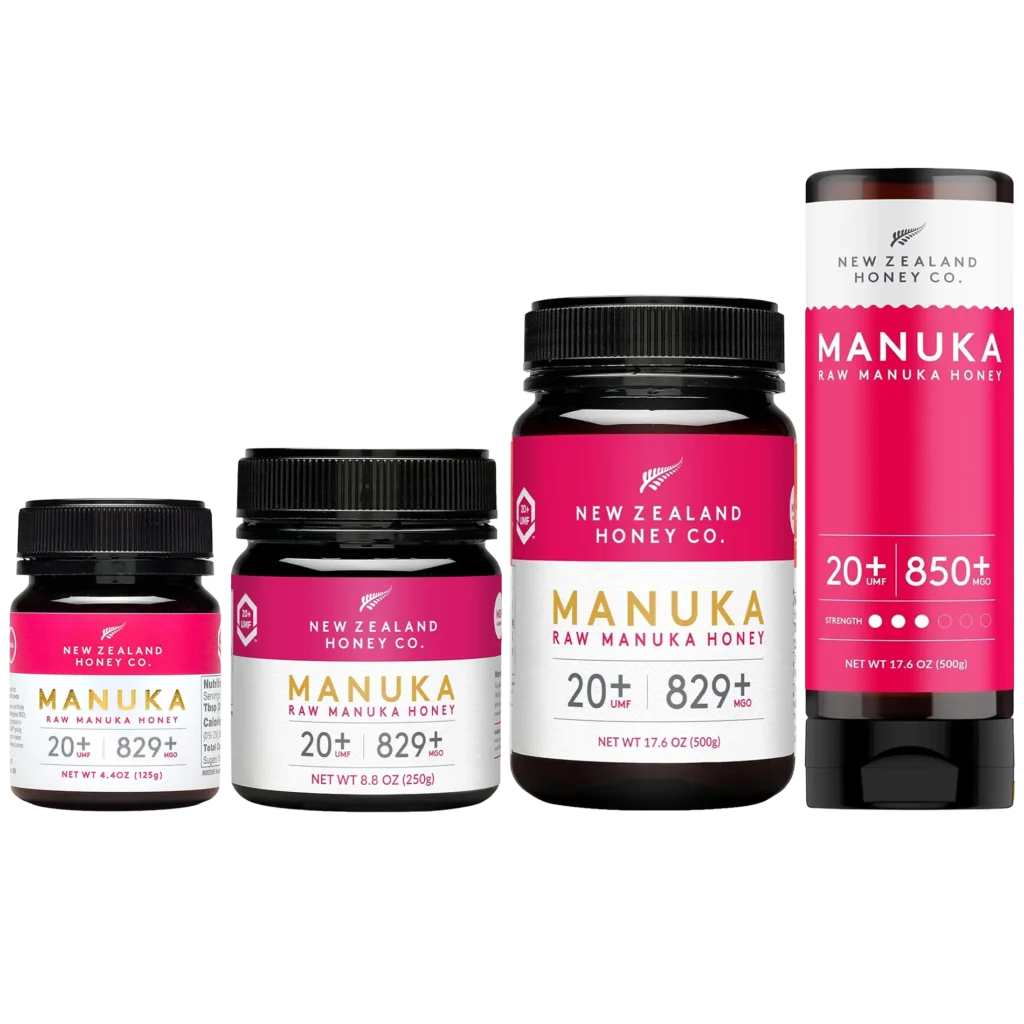
Compare your jar to the product shown below. If it doesn’t match, contact us.
Official UMF™ Certificate
This is the official UMF Certificate for the jar you have purchased.
Sample ID: 639820
639820
Country of Origin
New Zealand
Click Image to Zoom
Region of Hives
Region where your Mānuka Honey was sourced:
This certified Mānuka honey from New Zealand Honey Co. Limited (Sample ID 639820) carries a UMF 21 grading, which is an independent measure of the distinctive Mānuka markers that indicate quality and non-peroxide activity; in short, a higher UMF means a stronger, more concentrated Mānuka profile. The laboratory report from Hill Labs in New Zealand shows an MGO (methylglyoxal) level of 901 mg/kg — MGO is the chemical indicator most commonly used to express Mānuka’s antibacterial activity. Leptosperin is recorded at 500 mg/kg, a botanical marker that helps verify this is genuine Mānuka honey. DHA (the natural precursor that converts into MGO as honey matures) is not shown on this certificate, but it’s the compound that influences how MGO can increase over time. With levels well above 500 MGO, this is a high-strength Mānuka that many people choose for targeted uses such as gut support, immunity, beauty, wound care and skincare, while still being a lovely, flavoursome choice for daily favourites like toast or a morning tea boost.
In short: A premium, high-strength UMF 21 Mānuka honey (MGO 901 mg/kg), independently tested by Hill Labs and brought to you by New Zealand Honey Co. Limited — genuine, potent, and versatile.
This certification confirms the authenticity and quality of your Mānuka honey purchase.
All testing performed by independent, accredited laboratories.
This Mānuka honey is

Mānuka Honey Certification Details
Sensory Profile
Colour
Flavour
Texture
Mānuka Honey FAQ
Why is this honey so expensive?
It’s harvested in remote areas of New Zealand and undergoes rigorous independent testing for quality, purity, and potency — all of which adds cost. Rarity and global demand also play a role.
The colour of my honey looks different. Why?
Colour can vary naturally by batch and region. It doesn’t indicate strength or efficacy; a high-MGO honey can be light, and a lower-MGO honey can be dark and visa-versa.
My honey is too hard/runny. What’s wrong?
Temperature affects viscosity. To soften, leave it somewhere warm. To firm, chill in the fridge briefly.
This Mānuka Honey tastes bitter — is it off?
High-grade Mānuka can taste bold or slightly bitter due to potent bioactive compounds. Honey doesn’t spoil in the usual sense; gentle warming can reverse crystallisation.
How is Mānuka honey different from regular honey?
Mānuka contains higher levels of methylglyoxal (MGO) and carries a UMF™ rating based on independent lab tests of key markers.
New Zealand Honey Co. is committed to complete transparency. Sourced from hives across New Zealand’s rugged, untouched landscapes, the honey is UMF™ certified, fully traceable back to the hive, and free from GMOs, glyphosate residue, antibiotics, or additives.
The company follows a simple principle: nature is best preserved in its purest form.