Authentic UMF™ Certified
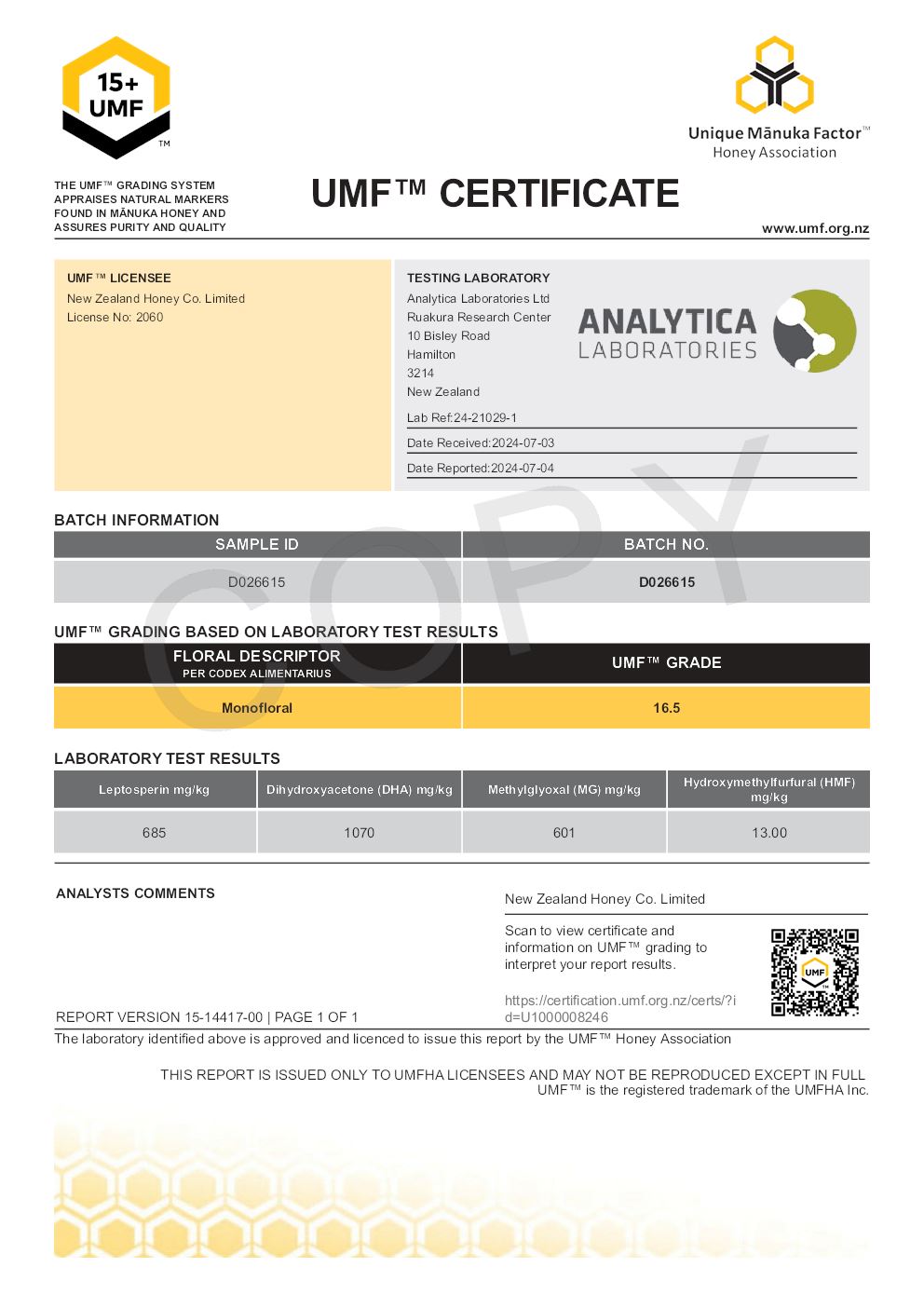
UMF™ Certificate: Batch ID: #D026615
Testing Laboratory

Valid Certificate Search
Monofloral
UMF™ GRADE
16.5+

Product Verification
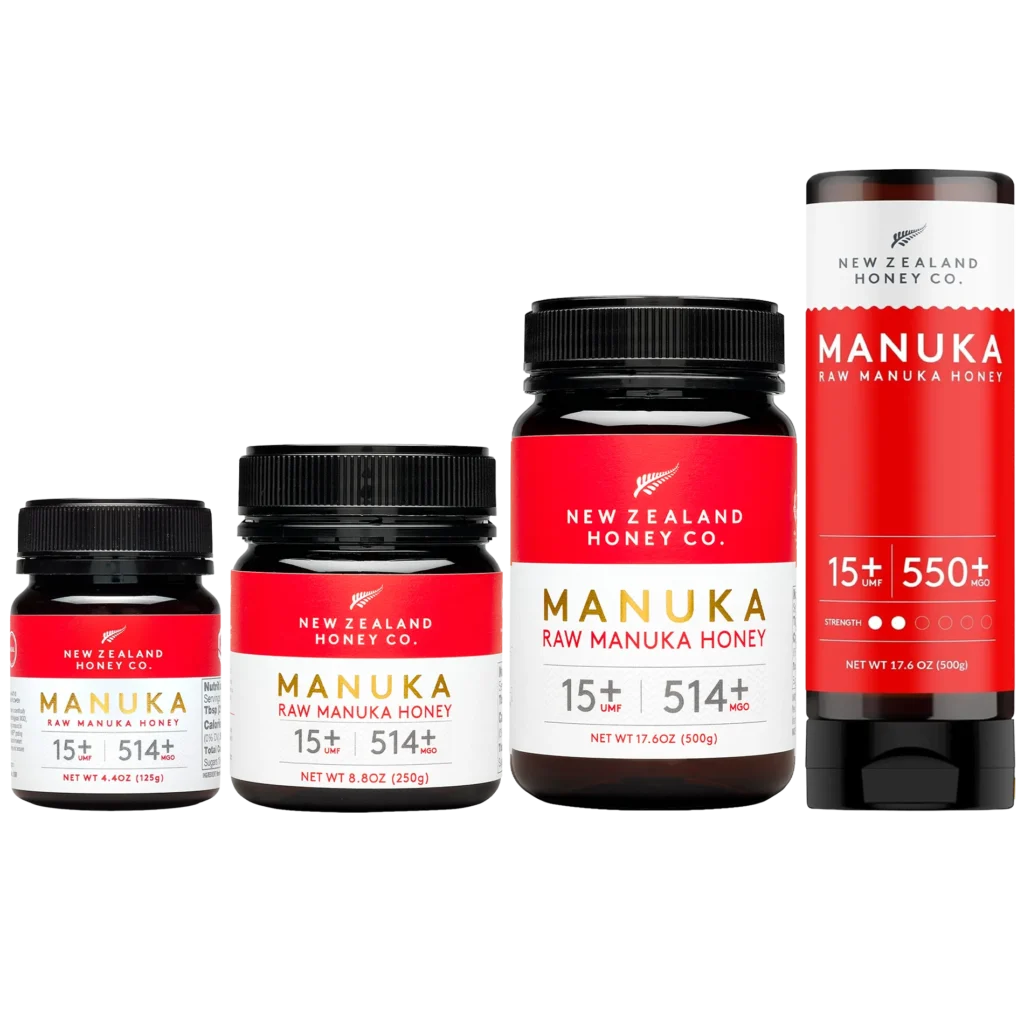
Compare your jar to the product shown below. If it doesn’t match, contact us.
Official UMF™ Certificate
This is the official UMF Certificate for the jar you have purchased.

Sample ID: D026615
D026615
Country of Origin
New Zealand
Click Image to Zoom
Region of Hives
Region where your Mānuka Honey was sourced:
This batch (Sample ID D026615) from New Zealand Honey Co. Limited was independently tested by Analytica Laboratories Ltd in New Zealand. It carries a UMF grade of 16.5, which signals a premium manuka profile beyond ordinary honey — UMF measures the unique non-peroxide activity associated with manuka. The MGO (methylglyoxal) result is 601 mg/kg; MGO is the compound most commonly used to indicate antibacterial potency, and at this level the honey sits well above the 500 mg/kg threshold that many people look to for more intensive uses. The certificate lists Leptosperin at 685 mg/kg — a botanical marker that supports the genuine manuka origin of the honey. DHA, the natural precursor that converts to MGO during storage, is not shown on this report. Overall, this is a high-MGO, UMF 16.5 honey from a reputable licensee, making it a great choice for shoppers who prefer a stronger manuka for immunity and beauty-supporting routines, wound-care-friendly skincare formulations, or anyone wanting a robust, high-grade manuka in their pantry.
In short: UMF 16.5, MGO 601 mg/kg, Leptosperin 685 mg/kg — independently tested by Analytica Laboratories Ltd (New Zealand); a high-MGO, premium manuka from New Zealand Honey Co. Limited, ideal for more intensive everyday and topical uses.
This certification confirms the authenticity and quality of your Mānuka honey purchase.
All testing performed by independent, accredited laboratories.
This Mānuka honey is

Mānuka Honey Certification Details
Sensory Profile
Colour
Flavour
Texture
Mānuka Honey FAQ
Why is this honey so expensive?
It’s harvested in remote areas of New Zealand and undergoes rigorous independent testing for quality, purity, and potency — all of which adds cost. Rarity and global demand also play a role.
The colour of my honey looks different. Why?
Colour can vary naturally by batch and region. It doesn’t indicate strength or efficacy; a high-MGO honey can be light, and a lower-MGO honey can be dark and visa-versa.
My honey is too hard/runny. What’s wrong?
Temperature affects viscosity. To soften, leave it somewhere warm. To firm, chill in the fridge briefly.
This Mānuka Honey tastes bitter — is it off?
High-grade Mānuka can taste bold or slightly bitter due to potent bioactive compounds. Honey doesn’t spoil in the usual sense; gentle warming can reverse crystallisation.
How is Mānuka honey different from regular honey?
Mānuka contains higher levels of methylglyoxal (MGO) and carries a UMF™ rating based on independent lab tests of key markers.
New Zealand Honey Co. is committed to complete transparency. Sourced from hives across New Zealand’s rugged, untouched landscapes, the honey is UMF™ certified, fully traceable back to the hive, and free from GMOs, glyphosate residue, antibiotics, or additives.
The company follows a simple principle: nature is best preserved in its purest form.